Kate Kincaid and Amy Davis, authors of Ketamine-Assisted Psychotherapy Treatment Companion reflect on their take-aways from the Chacruna Psychedelic Conference
Check it out!
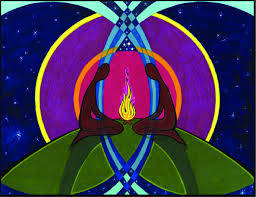
Integrative Science Vision, aka Common Ground, painting by Basma Kavanagh retrieved from Google 5/7/26
Amy’s Reflections
The Psychedelic Culture conference is hosted by Chacruna, the institute for psychedelic plant medicines, gathers speakers from all over the world — including Indigenous leaders who practice traditional medicine healing — to encourage conversation and education about social justice issues in the Psychedelic Renaissance.
Research into the use of psychedelic medicines to treat mental health concerns has been accelerating since its resurgence in the late 1990s.
On April 18, 2026, the President of the United States signed an executive order directing the FDA to fast-track its review of psychedelic medicines, including Ibogaine, a psychoactive compound derived from the Iboga plant native to Central Africa, shown to be effective in treating addiction and traumatic brain injury. This order was signed while several hundred people were gathered at the Chacruna conference.
Reactions in the room were mixed.
People were excited that these developments signal a shift in how Western medicine is beginning to engage with substances that Indigenous communities have used ceremonially and therapeutically for centuries. There was also a palpable urgency to ensure that policy, practice, and research honor the important responsibility they carry regarding what gets studied, how it is measured, and which knowledge systems are considered valid.
One primary concern in this renaissance is the tendency of Western science to position itself as the ultimate authority while simultaneously reaching for Indigenous knowledge to frame research protocols — preparation, ceremonial music, therapeutic support — and leaving Indigenous leaders out of the conversation, dismissing that very knowledge system as irrelevant to understanding how these medicines work.
Western science often focuses narrowly on the drug’s interaction with the brain, stripping away cultural and contextual factors.
The field risks producing findings that are not only incomplete, but extractive —taking from Indigenous traditions without accountability to those communities and dismissing the wisdom of the very knowledge systems from which this healing modality originated.
The most important takeaway I received from this conference is the importance of relationships. Many presenters spoke about reciprocity, a concept I have been immersed in this semester through a class in my doctoral program called Traditional Indian Medicine (TIM). TIM is a worldview encompassing scientific philosophy, ceremonial practices, and healing traditions centered on relationships — to land, water, air, animals, people, ancestors, and the cosmos. At its foundation is the understanding that all things are composed of energy, which TIM calls spirit. A core teaching is that human survival depends on the earth, and through the principle of reciprocity, we are responsible for protecting her, most especially water, recognized as a living being.
Reciprocity holds that when we are cared for, we return that care through gratitude, protection, or caring for others — a circular, self-sustaining exchange of energy.
This is why there is such a significant need to indigenize clinical research into plant medicines and psychedelic compounds. Scientific inquiry will be most impactful when conducted through the lens of Native scientific philosophy, which relies on observation much as Western science does, but with a broader scope. Rather than isolating the relationship between two variables, it situates those variables within larger systems and includes the subjective experience of the observer as part of the inquiry — with the understanding that all phenomena exist through the nature of energy and relationships.
In psychedelic-assisted care, the relationship between participant, medicine, environment, and support systems all potentially contribute meaningfully to outcomes. Yet some researchers maintain that the mechanism of action is purely the drug’s interaction with the brain, and that contextual factors are merely safety measures with no relevance to outcomes. This debate is not new to mental health. Researchers Wampold and Imel spent three decades investigating which therapeutic factors actually drive healing, initially expecting to confirm that specific interventions like cognitive behavioral therapy were most responsible. What they found instead was that so-called “extratherapeutic factors” — the client’s motivation, the therapeutic relationship, social and cultural context — contribute to healing in a much larger way.
These findings mirror what Indigenous epistemology has long held: that healing cannot be understood by isolating its parts.
These ideas have been central to my doctoral work, and they brought me to the Two-Eyed Seeing model, developed by aboriginal elders Cheryl Bartlett and Murdena and Albert Marshall of the Mi’kmaw Nation in Canada. The model represents Indigenous ways of knowing coming to a common fire with Western ways of knowing, so that the two can share wisdom. My professor, Dr. Milicent Pepion, said that a fire does not discriminate against who she warms — she invites all to come and be warmed. Each knowledge system has something to offer.
It can be hard to see what Western science has to offer when so much of it has been used to erase and oppress. We are taught from an early age to privilege this system above all others, and that history makes one ready to “throw the baby out with the bathwater” (thanks, grandma) because so many have been harmed. And yet, there are aspects of Western thought worth keeping — the reservation of judgment until sufficient evidence has been gathered, and the effort toward a neutral stance that keeps us in a learner’s mind, less likely to bias our findings with our own hopes and expectations. These are useful tools.
When people on either side of the fire feel rejected by the other, defensiveness arises. The Two-Eyed Seeing model offers a different possibility — one where the two knowledge systems are in conversation rather than competition, and where we begin to recognize that they often converge on the same conclusions. I left this conference more committed than ever to the idea that the most meaningful research in this field will emerge not from one system dominating the other, but from genuine relationship between them. I hope my future research and writing can be a place of common ground and balance — and a fire that warms everyone who comes to it.
Kate’s Take-Aways
The conference was held over Bicycle Day, the anniversary of Albert Hofmann’s first intentional LSD trip in 1943. One of the speakers made the observation that we are all on that bicycle right now, not entirely sure what is happening or where we are going, and that the task is to sit with the discomfort and the contradictions rather than reach for false clarity. That felt true to me all weekend.
I went to this conference as a therapist and as a founder, but also as a queer person, a neurodivergent person, a parent, and someone who has her own lived relationship with altered states of consciousness. I was not there as a neutral observer. And one of the things the conference kept returning to was that there is no such thing, really. The presence of the observer is always part of the inquiry.
One of the things that moved me most was a line from Bia Labate’s opening remarks. She asked:
“How did we arrive here? Where a trial has more legitimacy than a ceremony? Where a licensed therapist has more than a curandera? Can we name what has happened? We must.”
I kept coming back to that question all weekend.
At TCA, we have been doing ketamine-assisted psychotherapy for some time now, and I have sat with clients in those spaces and felt something that data alone does not capture. Sound is one example. I had my own experience with Joe Tafur that involved icaros, the healing songs used in ayahuasca ceremony. I felt the music as something physical, something that moved through the body rather than simply into the ears.
Sound is touch. That is not a metaphor.
The conference kept pointing at this kind of knowing, the kind that lives in the body and in relationship, and asking us to take it seriously as evidence.
There was a talk on neurodivergence that I did not expect to hit me the way it did. The presenter, Staeven, was unapologetically queer and neurodivergent and fully himself, and the room loved him for it. I sat next to a woman who made me laugh the whole time. He said something I want to carry into how I show up at TCA: wanting to know what comes next is not anxiety. For neurodivergent people, clear expectations are not hand-holding. They are what makes presence possible. I have been thinking about how often we ask clients, and honestly ourselves, to just tolerate uncertainty when what would actually help is someone describing clearly what happens next, and then what happens after that.
I also attended a workshop that wove together parenting, ritual, and psychedelic states in a way I was not prepared for. The presenter talked about mothering as a form of ritual practice, and care as a kind of ceremony. I thought about rubbing lotion on my 3 year old daughter’s feet and suddenly that small nightly act felt like something worth honoring. The workshop talked about lullabies as tools for helping children develop what they called agency, the capacity to navigate state changes, to self-soothe, to enter and exit altered states of consciousness with some sense of authorship. The idea that we can teach our children to be agentic in their dreams, to turn and face the monster rather than run, and that this develops a skill they will carry into waking life, was one of the more quietly radical ideas I encountered all weekend.
There was also a line that has stayed with me from the storytelling session. Mikaela de la Myco talked about the importance of telling your story to people outside of this community, people who are not already convinced. She said: just tell your story and the right people will hear it. And when you tell your story, you get it right. It inspired me to share more and reminded me to make time to do it.
The conference closed with some tension, a protestor stood up and challenged one of the MAPS founders about the organization’s work in Israel rather than Gaza. The room got uncomfortable. But Bia had told us at the very beginning that we would need to practice sitting with discomfort, and there it was, right at the end, a chance to do exactly that.
Complexity is a precondition to progress.
That was another line I wrote down and did not want to forget. I left feeling the way I sometimes feel after a good ceremony. A little tender. More porous than when I arrived. Recommitted to the work, and to doing it with more honesty about who I am and what I am still learning. At TCA, we talk a lot about being a practice that is for humans, by humans. What this conference reminded me is that being fully human means staying in relationship, staying curious, and being willing to not yet know.